Tuesday, 15 October 2019

Reform and renewal: printing after 1958

When Whitehouse died in 1955 his controlling share in the Education Trust Ltd, owners of Bembridge School, was inherited by R.G. Lloyd and it was he who invited James Dearden, who as a boy at Bembridge had occasionally worked closely with the Warden (and whose family knew him socially, to some extent, as well), to return and assist in sorting out Whitehouse’s papers. These were in some disorder: every year around Foundation Day Whitehouse would sweep the accumulation of unfiled material on his desk – this might include anything from the most ephemeral piece of administrative paperwork to a half-opened packet of Ruskin purchases received from his agent - into a tea-chest which would be put into storage. But although the post, which began in May 1957, was only supposed to be temporary, it was apparent – not least in the number of scholarly enquiries about the Ruskin collection now finding their way to the school - that there was an opening for a curatorial position of much broader scope than the job originally envisaged, and that given the value and likely historical importance of Whitehouse’s collections, it would be of long-term significance.

Tom Stedman, the much over-burdened Second Master, was keen to give up the position of Printer which he had held since 1935. With this in mind, Dearden suggested to the school Board that if he was given a permanent job as Curator, then he would be prepared, in addition, to teach printing. His offer was accepted and Stedman stood down as Printer (but he retained the editorship of the school newspaper, which  had fallen to him after Whitehouse’s death).

Looking back one can see that a certain neglect in the printing room had been evident for some time. In the decade or so after 1945 there are several signs of what is, at best, an irregularity of oversight. It’s most likely that this was the result of the extra work Stedman had had to take on elsewhere in the school both before and after the accident, in 1953, that incapacitated Whitehouse, and from which he never really recovered. Stedman may often have been relying on older boys, in his absence, who were of varying competence. One senses, too, that the Guild hierarchy was no longer the socially cohesive force it may once have been, and had become less effective in developing the range of printing skills amongst all those using the printing room. Ever erratic (except during some exceptional periods of concentrated effort), the quality of presswork of the school newspaper once or twice plumbs the depths during this period. For the first time there are long spells of no news at all in the newspaper of the activities of the Guild, and although the printers were still quite capable of rising to occasions such as the 100th issue, or the Whitehouse memorial issue, towards the mid-1950s serious mistakes in production start to crop up: for example, in the summer issue, 1955, there is a basic error of imposition, something previously unheard of, and the problem recurs in the spring of 1957, resulting in deletions by hand to the table of contents. Finally, in the summer of 1958 – and perhaps with the new Printer now in sight – we find the printers having to resort to abject apology: they’ve been unable to complete their make-ready. It’s odd that the resources weren’t available to solve their problem:

We apologise for not being able to print any wood engravings. The blocks themselves were not type high and it proved impossible to make them up sufficiently for them to print well and also to allow the type to print.

(In mitigation, it might be added that throughout this period the standard of correction had remained high.)

The first issue of the school newspaper under Dearden’s direction was that of the autumn (then styled Michaelmas) term, 1958, where it is recorded that ‘he has already begun operations in the printing room and will soon have qualified to discard his L’. He had spent some time in the summer term learning the craft from Stedman, while printing the pamphlet Printing at Coniston. He had already made an impression at New House where it was noted that ‘the Ruskin Galleries have been brought increasingly into the life of the school’. There he had begun, the previous autumn, with an exhibition of private press books, creating ‘a great interest in book production’.

Another show from the beginning of his curatorship was an exhibition devoted to the school’s connection with the Norwegian explorer Fridtjof  Nansen. In the autumn of 1959 the subject was the Yellowsands Press itself, its history surveyed in forty exhibits, from Whitehouse’s Ruskin Centenary Council circular of January 1919, printed at 13 Hammersmith Terrace, to the latest edition of the school newspaper. Two years later there was a month-long exhibition of illuminated manuscripts and calligraphy (including items from Dearden’s own collection). One of the highlights was the illuminated address to Ruskin on his 80th birthday which Whitehouse had presented personally at Brantwood in 1899.

At least one of these early shows was formally visited by pupils, masters bringing their classes by appointment, and one is reminded in all this of the conduct of the pre-war exhibitions, something of whose spirit it was doubtless the intention to revive as the fortieth anniversary brought with it a deepened sense of the school’s historical identity.

From the point of view of the printers, however, what stands out here is Dearden’s interest in formal manuscript and its decoration. While his first work in the printing room is (not surprisingly) largely indistinguishable from his predecessor’s, a passion for visual enrichment soon makes itself felt. From it, over the next few years, would emerge the antiquarian style of decorative jobbing which was his distinctive contribution to Bembridge printing. The long austerity into which the Yellowsands Press had settled was at an end. Henceforth there would be a place for colour, pattern and ornament, and a real opportunity for a revival in wood-engraving. There would be a new sense of ambition and self-confidence in the printing room, and a fresh enthusiasm in which many would be caught up (and a few find a vocation). It took only a modest new investment in type and other equipment to effect a wide-ranging impact.

The acquisition of a treadle-operated, vertical platen press was originally the idea of the new headmaster Peter Rendall who took up his duties at the beginning of the autumn term, 1959. The tradition of printing the school newspaper on the Albion hand-press was unshakeable (and not questioned by Dearden) but the new press would vastly increase the range and quantity of smaller jobbing work which could be undertaken. It would also facilitate more individual pupil projects and, if only implicitly, provide a new focus for care in craftsmanship in the printing room.

But the process of renewal began before that. The startlingly crisp and bright impression of the Spring (Lent) 1959 issue of the newspaper shows that a great deal of worn type had been replaced (it was the first new type for twenty years) and with it comes a marked improvement, for a time, in presswork.

A foolscap folio treadle platen press by Jardine of Nottingham, built c.1940, was installed in 1961, and from then on the now regular notes on the printers’ Guild usually contain an impressive statistic of jobs completed each term. The stiff grey wrapper (described by Dearden as ‘peacock blue’; but perhaps they were different shades), which had had to be abandoned during the war, was restored to the newspaper (the wrapper was now printed on the new press). After forty years of printing without any at all, fonts of 12 and 18pt Caslon italic were obtained and the worn 18pt roman used for headings was replaced (it was no longer available on a 16pt body). Some 36pt Caslon, roman and italic, was bought and this, the main phase of the expansion of the typographical resources at Bembridge, was completed by the acquisition of three sizes of Stephenson Blakes’s Old Face Open (12pt – a mistake, surely, and rarely used - 18, and 30pt). (A little later there came a few other typefaces, notably Perpetua Light Titling, used mainly as a drop initial, and Poliphilus and Blado. The former was very seldom used, but the strongly calligraphic Blado italic, stocked eventually in both text and display sizes, became the standard face for a particularly luxe style of printed order of service evolved later in the decade.)

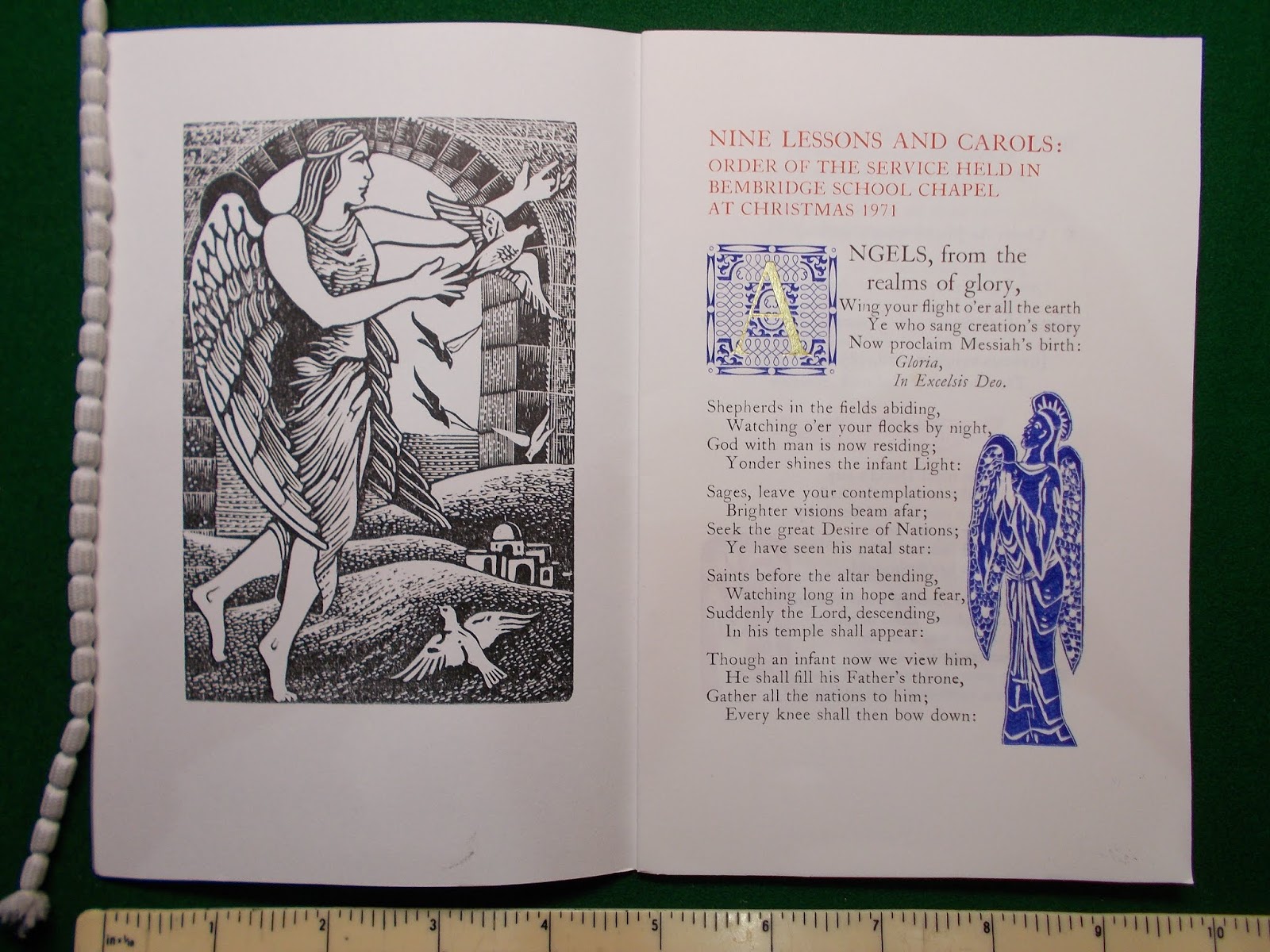
The outstanding product of the new order, however, and to many now emblematic of Bembridge School printing in its post-war reformation, is the series of annual Nine Lessons and Carols service orders, booklets of up to sixteen pages, which was begun in 1962. The design - typically including wood-engravings and ornamental initials, printers’ flower arrangements and sometimes extensive use of colour – proved long-lived, the last example being produced in 1986. These are perhaps the most potent of all Yellowsands ephemera in their power to evoke a particular time, place and atmosphere, and to those who took part in printing them, they were objects of pride.


The quality of the wood-engravings available would naturally vary but the basic typographic arrangement altered little from year to year. The first carol service order was printed entirely in black, but thereafter the decorative elements were elaborated, with the introduction of red and blue ink (requiring, of course, multiple pressings), and in 1964 the addition, for the first time, of a gold initial. This was printed cold, on a new Adana 85, from a foil which was actually a stationer’s product intended for writing with a biro - and while the newspaper’s claim that the process ‘not only breaks new ground for the Press but has almost certainly never been used before in the printing industry’ was overblown, there’s no doubt that it worked (after half a century there’s been no loss of adhesion, and the gilding remains bright)*.

*In the 1970s and 80s the wrapper of the carol service orders was dropped, which was a pity, but they perhaps gained from the use of a soft white wove instead of the Yellowsands standard, Abbey Mills Antique Laid, which was a rather brittle-surfaced esparto paper and not always easy to print.

*
The printing requirements for the celebrations around the school’s fiftieth anniversary in 1969 created a flurry of activity in the printing room. They included various programmes, a richly-worked order for the main chapel service of thanksgiving, and a traditional printers’ keepsake for the visit of Earl Mountbatten. The occasion was marked also by the publication of A Yellowsands bibliography 1919-1969 (two years before, Dearden had put out a call for information from old boys about fugitive pieces). But after forty years at the school, Tom Stedman retired (no-one had given more to Bembridge School) and the editorship of the newspaper passed to Harold Carnell, the first of several, relatively short-lived incumbents in a voluntary role it would become increasingly difficult for the school to fill.

Various attempts were made over the next twenty years to broaden the appeal of what was now perceived as a somewhat out-moded stiffness and formality both in the look and content of the school newspaper, but few made much impact on its essential character. Most noticeably, the notes on arts and crafts which had been prominent from the beginning were dropped entirely by the new editor and only restored in 1978 (as a consequence, there are no printers’ Guild notes during this period). There were a few excellent innovations: the interviews with older members of staff, for instance, though they’re much too short. But some mistakes, as well: the pointed substitution, for example, of (very coarse-screened) photographs for wood-engravings (which might not always have been very accomplished, but were at least pupils’ own work). There was a crossword - even, briefly (and much disapproved of by the Printer) advertising. The old grey cover was replaced by light pastel shades intended to reflect the seasons. From 1983, one of the Press’s miscellaneous type collections, a very Victorian gothic was dusted off for the title on what became a plain white cover, in a gesture that looks rather too self-consciously ‘retro’, and puts one in mind of nothing so much as how they might have printed at St Custard’s or St Trinian’s - but as the new age of desk-top publishing loomed there was a stubborn continuity in the typography within.

The unprecedented concentration of writing found in the newspaper in its latter years, about the tradition of printing at Bembridge, is partly a matter of the proximity of anniversaries and the memories these prompted, but also suggests defensiveness in what feels like an increasingly unsympathetic school environment. As late as 1986, however, it’s reported that in a general review of the arts and crafts curriculum the Governors’ external consultant had vindicated the educational practice of printing. I have been unable to establish exactly when printing ceased to be a timetabled subject (here Bembridge had been very unusual, if not unique, among school presses, which were mostly run as extra-curricular societies), but the consequences of the serious illness which temporarily removed Dearden from school in the mid-1980s seem to have made it inevitable. (In the summer of 1984, for the first time in its history, responsibility for the completion of the newspaper fell entirely on the shoulders of a boy, Mason Salmon, and the colophon of the Nine Lessons and Carols order of service that year states that it was ‘printed by M.J. Harrison’.)

Latterly, a sixth-form printing group appears to have met for a time - and right up to the last, a small number of individual devotees were drawn to the printing room. In 1988 it had been forced to move (to make way for a metal-working class) from the original, purpose-built premises, to two rooms in the old stable-block near Old House. The composing frames and treadle platens fitted in but the ceiling there was too low to open the frisket of the Albion.


Thursday, 26 September 2019

Some aspects of printing practice

The second number of Bembridge School Newspaper, published in the Spring 1920, records that the printers’ first work that term had been ‘to distribute the type of last term’s magazine’. One hopes they took care. ‘Dissing’ was always a chore, for the printing enthusiasts as much as for everyone else. It was often dirty work, as the type may not have been particularly well cleaned and might even be still wet with paraffin. In this condition a full stick of type for dissing was grim to contemplate. But the work had to be done accurately. Even then, confidence in dissing letters and punctuation well might not extend to spacing material. Thick spaces were easy enough but I can remember as a boy the effort of will, sometimes, required to distinguish thin and middle: I think the space boxes were often the first part of a type-case to get into disarray. But when one considers how perhaps fifty individual third and fourth formers, variously motivated (to say the least), were at different times using the same half dozen or so type-cases, the scope for muddle starts to become apparent. I can remember wandering with a last-minute job from frame to frame trying to find the least ‘foul’ case. (In an emergency, one might be given access to the office and the Printer’s private case and experience there the extraordinary luxury of finding that every sort one picked up was the right one.)


Extreme responses to the frustration and boredom of dissing included on one occasion, I recall, a boy simply picking up handfuls of type from his stick and sprinkling them like broadcast seed over the type-case. Another witness remembers seeing a boy quietly pocketing handfuls of type from his stick and at the end of the session walking over the football field and hurling them in disgust over the cliff. The type-cases used the most often – 12pt Caslon  – were commonly in a more or less foul state. For the conscientious compositor, this meant slow work, as every second or third sort had to be replaced in the right compartment before another attempt was made to secure the right one. But where the boy compositor had been (perhaps) happily chatting to his neighbour as he worked (the motto ‘A still tongue makes a full stick’ adorned the printing room wall before the war) the extent of his mistakes might only become apparent when his work was proofed.

‘The setting-up is exceedingly well done though the sorting still needs greater accuracy,’ remarks the school newspaper in the Spring 1923. But then in the Summer 1924: ‘This term has been chiefly notable for the much greater skill in distribution’. How long did it last? It would be quite wrong to assume that the fact that the matter is not mentioned again in the school newspaper for another three decades means that it did not continue to be an issue; more likely, it was so well established a problem as to be no longer worthy of comment. The Christmas 1960 number reports that the lower forms of the senior school had then been reorganised, allowing ‘more periods of printing [in] much smaller groups’ and there had been in consequence a notable improvement in workmanship, except distribution: ‘Here much more care must be taken, for bad distribution means a great deal of correction in the galley if the compositor does not take great care with his work’.

In 1959, while visiting Oxford as part of the arrangements for the publication of Ruskin’s Diaries, edited by Joan Evans, Jim Dearden became acquainted with the antiques dealer and private press bibliographer William Ridler and for a dozen years or so from the mid-1960s sent him for his collection an annual packet of Yellowsands proofs, trials and dummies, etc. These are now in the John Johnson Collection. They contain some spectacular examples of careless schoolboy setting. (The sheer number of mistakes often reminds one of the specimens of corrected setting which usually accompany the table of proof correctors’ marks in printers’ manuals or authors’ guides to printing - to which a note is sometimes added reminding the reader that this is of course not the frequency of error which will ever be found in practice.)

Occasionally, the compounding of error with misplaced skill achieves a kind of sublimity. In one proof, the text of a hymn, the first lines have been methodically indented, at first glance to accommodate a drop initial letter to be inserted later – except that, carefully centred in the space created there is a small figure in parenthesis: it’s the number of the piece of copy being set. The parentheses are as close as the compositor has been able to get to the circle in the manuscript indicating that the matter within it is not to be set.

Five years in to his long tenure as Printer Dearden compiled some Notes & Rules for Compositors at the Yellowsands Press (1964) which appears to be the only surviving such reference work produced by the Press. It’s a sixteen-page style guide cum printers’ glossary cum index of common errors, and provides an interesting (and not wholly predictable) reflection of some of the problems and potential mishaps of composing room practice.

Accented letters: When setting accented letters, it must be remembered that the accent is reversed on the type.

Confused letters: The following pairs of letters are frequently confused, especially in distributing: b d, p q. The letter on the actual piece of type is reversed, so that when the type is examined, the nick being downwards, the ‘b’ looks like a ‘d’, ‘p’ like ‘q’, and vice versa.
The letters ‘u’ and ‘n’ are frequently inverted and used in place of each other. This, too, should be avoided…

Care should be taken to differentiate between o (oh) and 0 (nought). Study the examples to see the different shapes…

Leads & reglets: Care should be taken to use leads and reglets that are the same length as the line of type.

Spacing: To justify a line of type the spaces must be changed working outwards from the centre using (when spacing up) combinations of spaces in the correct sequence as shown in the table of comparative spaces. It is not permissible to put in an extra space to fill up a line.
Spaces may be put at the end of a line only if it is the last line of a paragraph or a line of verse. In these cases the largest space used should be put at the end of the line.
There is no space between a word and the punctuation following it.

Titles: must be set in the type specified on the manuscript.

Correcting poorly spaced setting could be particularly demanding, lacking the reward of the immediate clarification of language. One vice was the impatient forcing-in of spacing material. In the worst cases, the compositor might actually contrive to gradually increase the line length to which his composing stick had been adjusted. Sometimes it was quicker just to start again.

It’s remarkable, looking through Bembridge School Newspaper over the seven decades of its existence, how few typos there are – and how few indications, in the notes on the activities of the printing room, of the extraordinary feat of proof-reading and correction that lay behind the exclusion of error. But the consequence of this was that the common, amateur printer’s bias in favour of accuracy in composition, over careful presswork, was entrenched.

Doubtless there were boys – there must have been many of them over the years - who interested themselves in the arts of making ready and achieving a consistent quality of impression on the Albion, but such was the vigour of the publishing imperative at Bembridge, conditions in the printing room were frequently against them. As one observer has noted, working the hand press was often treated as a kind of sport, ceasing, at times, to be a printing exercise at all. In the fifty-four years of printing before the Newspaper was finally put on machine*, phases of sustained improvement in presswork tend to coincide with either the arrival of a new Printer, obviously intent on making his mark, or (an even rarer event) the purchase of new type. Certainly, in the 1960s - perhaps the high point of printing at Bembridge School - such tasks as the preparation of the tympan or the adjustment of the platen, were largely the province of the Printer. There being no general investment in them on the part of the boys, standards of presswork might easily slip. Nevertheless, term after term, the Newspaper was got out. Though it was still then the custom for masters to address even the most junior boys in the senior school as young adults, somehow expecting them thereby to behave as such, we were most of us still children, and we were having fun.

*Spring number, 1973. It was a change Dearden always regretted, but as he explained, it had became necessary because in the busy final weeks of term the availability of a team of four printers, as and when each forme was ready, could no longer be relied upon. The printing of the Newspaper was transferred to a Furnival vertical platen acquired from Lightbown’s, of Ryde, a few years before.


Thursday, 19 September 2019

List of sources


Collections and archives


Bembridge Heritage Centre, Bembridge. Two files of material relating to Bembridge School assembled by local historian John Woodward.

Bodleian Library, Oxford. John Johnson Collection. 99/00-37 Yellowsands Press. Packets of proofs, trial pages, dummies, etc., mainly relating to the Nine Lessons & Carols service books of the 1960s and 70s. Originally collected by the private press bibliographer William Ridler.

Isle of Wight County Records Office, Newport. Whitehouse Archive. AC96/52. An index compiled by Jim Dearden covers about one third of the archive.

Oxford University Press archives. Correspondence of John Johnson.

Ruskin Library, University of Lancaster. Yellowsands Press collection, including a complete set of Bembridge School Newspaper. Not catalogued but a checklist is appended to this article.

Ryde School, Bembridge Boarding House. Bembridge School archives stored mainly in the common room, formerly the Lower Gallery, New House. Material formerly in the attic was transferred to Ryde, 2018-19.

Thomas Fisher Rare Book Library, Toronto. Yellowsands Press collection. 35 boxes, including a complete set of Bembridge School Newspaper, otherwise material mainly from c.1960 on. A box list is available from the library.


Books and articles


Bembridge School Newspaper 1:1 – 74:220, 1919-92.

DAY (Robin) Grand inquisitor: memoirs. London: Weidenfeld, 1989.

Dearden (J.S.) ‘John Howard Whitehouse, 1973-1955’, article, first published in 2004, in the Oxford Dictionary of National Biography.

______ Notes & rules for compositors at the Yellowsands Press. Bembridge: Yellowsands Press, Summer 1964.

______ Printing at Bembridge School. Totland Bay: M.J. Conder, January 1965.

______ Printing at Coniston. Bembridge: Yellowsands Press, June 1958.

______ Rambling reminiscences. A Ruskinian’s recollections. London: Pallas Athene, 2014.

______ Ruskin, Bembridge and Brantwood: the growth of the Whitehouse Collection. Keele: Ryburn Publishing, 1994.

[Dearden (J.S.)] A Yellowsands bibliography, 1919-1969. Bembridge: Yellowsands Press, 1969.

EAGLES (Stuart) ‘Ruskin’s ‘true disciple’?: John Howard Whitehouse (1873-1955) and Ruskin’s legacy’, pp. 232-61, in After Ruskin. The social and political legacies of a Victorian prophet, 1870-1920. Oxford: OUP, 2011.

HEATH-STUBBS (John) Hindsights. London: Hodder & Stoughton, 1993.

MORGAN (M.C.) Bryanston 1928-1978. Blandford, 1978.

RIDLER (William) British modern press books. A descriptive checklist of unrecorded items. New ed. 1975.

STEDMAN (T.M.) Bembridge School. The first forty years. Bembridge: Yellowsands Press, June 1959.

STEWART (W.A.C.) The educational innovators. Volume II: progressive schools 1881-1967. London: Macmillan, 1968.

WAKEFORD (Brian) Today well lived. The Bembridge School story, 1919-1994. Bembridge, [1994].

WHITEHOUSE (J. Howard) An account of the Yellowsands Press. Edited by James S. Dearden. Bembridge: Yellowsands Press, 1961.

______ Ed. Bembridge. An historical and general survey by members of Bembridge School. Oxford: Printed at the UP, 1923.

______ Creative education at an English school. Cambridge: Printed at the UP, 1928.

______ The craftsmanship of books. London: Allen & Unwin, 1929.

______ Education. London: Rich & Cowan, 1935. A volume in the ‘In my time’ series. Others included Marriage by Marie Stopes, Music by Hubert J. Foss, Literature by Compton Mackenzie and Art by Frank Rutter.

______  Ed. The English public school. A symposium. 1919.

______ Thy youth and cause. Cambridge: Printed at the UP for the Yellowsands Press, 1934.

WILDMAN (Stephen) [Compiler] Keeper of the flame. John Howard Whitehouse 1873-1955. [Catalogue of an exhibition at the] Ruskin Library, Lancaster University, 30 April – 2 October 2005. Includes essays by J.S. Dearden and Stuart Eagles.


Monday, 22 July 2019

Bembridge School, c.1960


Part of an aerial photograph of Bembridge School, c.1960. Central row of buildings, left to right: the gym, the science block, the form block, the woodwork room (originally the Yellowsands camp mess, then the Arts and Crafts Room), the printing room (steeply sloping roof), the squash court and the sports pavilion.

Friday, 5 July 2019

'An unorthodox visitor': Joseph Thorp

In other circumstances one would expect at least a mention in the school diary (in the 1920s and 30s written by the head boy), if not a note in the school newspaper, but both of these are silent: there is only one record of the extraordinary visit by the journalist and typographer Joseph Thorp to Bembridge School in the summer of 1931. This is a letter, written four decades later, from the antiquarian bookseller (and sometime Bembridge Master Printer) Anthony Doncaster, to the then headmaster, Peter Rendall. The letter is laid in to a copy of the Curwen Press Miscellany, 1931, which is preserved among the school records. After 43 years Doncaster had returned the book, rather reluctantly, to the school, where he now acknowledged it belonged, though as he explains, his possession of it up till then had been perfectly legitimate.


The book is inscribed thus: ‘For the students of the finest school in England, from “T”, 1931’. ‘T’ was how Thorp signed his reviews as theatre critic of ­Punch, which position he had held since 1915. But his main interests were in the fields of advertising, publicity and typographic reform. Born in 1873, and therefore an exact contemporary of Whitehouse, Thorp had spent ten years as a Jesuit priest before not so much abandoning – he appears to have been pushed – as translating his religious vocation into one of secular enthusiasm. ‘With the instincts of a professional entertainer’, his DNB biographer writes, ‘and a flair for making networks of personal contacts, Thorp adored trumpeting a cause’.

Chief among the causes he espoused was the improvement in design of everyday goods, especially printed matter, and as a leading light of the Design and Industries Federation, founded in 1915 (motto: Fitness for purpose), he belongs to that broad movement which sought the reconciliation of Arts and Crafts ideals to the needs of industrial production. Another of his causes (to which Doncaster alludes in his account of the lecture Thorp gave at Bembridge) was the development of a common language of signs in public spaces, where in Britain, at least, he was a pioneer.

The title of his Printing for business: a manual of printing practice in non-technical idiom (1919), a book ground-breaking in its day, speaks for itself. His monograph on Eric Gill, the first, appeared in 1929. At the time of his visit to Bembridge he was publishing the second part of an article on the standardization of letterform nomenclature. A quintessential figure of the inter-war typographic revival Thorp bursts into the Yellowsands story with a phenomenal potentiality. But Bembridge was hardly ready for him.

One obituary attributes his success as a theatre critic to the fact of his always being able to maintain ‘an eager expectancy’. An accomplished speaker, he was a born persuader and motivator of the shy and gifted, and with a social conscience too – in fact, though he was probably well to the left of him politically, as a reformer he had much in common with his Bembridge host – but he had a tendency to over-reach, and socially he was much too fast for Whitehouse.

Exactly how Thorp’s visit came about isn’t clear. Doncaster states that by coincidence Whitehouse had been reading a book or article by Thorp when ‘out of the blue’ he invited himself to stay. Thorp may have simply read about the activities of Bembridge School in the press (where in the early days especially the Warden was always busy promoting them), but it’s much more likely he was prompted by contact with one of the many friends and acquaintances he shared with Whitehouse.

In the present context, Emery Walker springs to mind, though there’s no evidence he had any involvement with Bembridge beyond his initial advice to Whitehouse on setting up a printing press and the loan of his name to the first school advisory council (more’s the pity, one’s tempted to add: judging by his commitment to some of the other presses who sought his advice, Walker might have had much more to contribute, had he been asked). More likely candidates are figures such as the artist Albert Rutherston, who had been the subject of an exhibition at Bembridge, or Claude Lovat Fraser whose work for the Curwen Press to a great extent characterises Thorp’s time with that firm as publicist, or indeed Thorp’s fellow Punch stalwart, the writer A.P. Herbert, a particularly warmly-received visitor to the school, who was Whitehouse’s tenant at Hammersmith Terrace. At any rate, Thorp arrived, and at first it seems that Whitehouse was delighted by his ebullient presence.

But it soon appeared that he [Whitehouse] had met his match in eccentricity and wayward behaviour…on being taken round the form rooms (and I was present when this happened), Warden with a flourish and with his usual gesture of flicking his fingers, said to T., ‘The boys in this school have the finest view of any school in England’. ‘Yes,’ snapped back Thorp, striding out of the room as he spoke, ‘and that is why they sit with their backs towards it, I suppose’.

Whitehouse was left stranded, but there was much more. Thorp seemed to find fault everywhere: the tools in the woodwork room should be replaced – Thorp knew where to obtain much better ones; similarly the equipment in the school laboratories. At supper, to which as Master of the Guild of Printers, Doncaster was invited, Thorp proposed that his wife should be commissioned to provide the school with ‘some proper murals’, but ‘You must buy a decent bed for her to sleep in – not one of those damned school beds you made me lie in last night’.

He threatened to stay at the school for a further week, but was somehow prevailed upon to leave, and it was then when in a state of distraction that the book…was thrust upon me with the remark from Warden that he did not want it to sully the name of the school.

Had Thorp and Whitehouse been able to make common cause typographically we can only guess at how the course of Bembridge printing might have been altered. As for the book, a wonderful gift had been spurned, a fine album of the best contemporary trade practice, historically informed (it includes an article by Harry Carter – late of the parish - on sanserif types), technically impeccable, a book which would become an icon of English typography between the wars – and to Thorp an object of special personal pride, he having introduced to Harold Curwen its editor and genius, Oliver Simon.


Doncaster, a typophile, certainly treasured it. The eldest of three brothers, all dedicated school printers who all, for a time, appear to have entertained the idea of a professional career in printing, he left Bembridge at the end of the summer term, 1932. By the autumn we find him resident at George Cadbury’s Quaker foundation, the Woodbrooke Settlement, Selly Oak (doubtless arranged for him by Whitehouse) and attending the Birmingham School of Arts and Crafts (and printing there?). He seems to have been something of a Whitehouse favourite, and as a senior printer with ‘the power to inspire a group of younger boys’ he was much missed in the printing room. One of his brothers, either Richard or Michael, was sent to Oxford the following year to meet John Johnson with a view to taking up a printing apprenticeship. But this came to nothing. There were none available in the foreseeable future and anyway, as Johnson explained, at 19 it was really too late for the young man. Apparently unaware of the strength of trade union rules, Whitehouse had been dismayed by Doncaster’s report when he returned to school that on being shown round the Oxford printing works he had not been permitted to so much as touch a piece of type.  


Tuesday, 11 June 2019

Acknowledgements


I would like to thank Richard Smout of the Isle of Wight County Records Office for trawling on my behalf the large uncatalogued portion of the Whitehouse Archive; also the following archivists and librarians for their help in various ways: Stephen Wildman (Ruskin Library, University of Lancaster), Michael Maw (OUP Archives), and Julie-Ann Lambert (John Johnson Collection, Bodleian Library). I am grateful to Sian Evans and Ann Sutton who enabled me to access Bembridge School records. Among the ex-pupils who got in touch with me, Mike Conder was especially helpful.

My chief debt is to Jim Dearden who has assisted my work at every stage, from the mapping of the sources, through his patient replies to my many questions about printing at Bembridge (and the history of the school generally), to the improvement of the emerging text.

Thursday, 6 June 2019

The society of the printing room

Though the guild system used at Bembridge (and other schools) in the 1920s and 30s derived from the arts and crafts movement, it had nothing to do, Whitehouse averred, with guild socialism in industrial organisation, such as that advocated by William Morris and G.D.H. Cole. His was rather ‘an experiment in reasonable freedom in education’, under which ‘certain special activities within the school have been organised in the spirit of the craft guilds of the middle ages’ – which left him with plenty of room for interpretative improvisation.


By Christmas 1920 there were probably still fewer than fifty boys on the school roll. But the newspaper that term reports the formation of no less than five guilds: woodworkers, printers, gardeners, builders and toymakers (for younger boys). Already from the autumn of 1919 the builders had been busy constructing a photographic dark room (a priority which reminds us that, while he had little time for modernism in art and literature, Whitehouse easily engaged with many features of technical modernity, including broadcast radio and the automobile – he liked big American cars) and by 1922, the gardeners had taken over a piece of ground to work, he says,

as a communal market garden, paying for the seed themselves, and selling the harvest to the school at current rates, and themselves deciding what they could [sic] do with the profit. It is a guild built on a basis of co-partnership. Careful accounts are kept…

However, all guilds, he maintained, would ‘undertake certain work for the general good of the school community’ – but some more, perhaps, than others.

In theory, at least, boys could join as many guilds as they liked, according to their interests. Each guild was ‘a little fraternity with three degrees of rank – apprentices, journeymen, masters.’

The boy passes from one to degree to another, according to merit, as he acquires the requisite skill. [The fraternity] is largely self-governing. The members of the guild have regular meetings, when they talk over the work they are doing, or contemplate doing – its difficulties and problems. They do a large part of the organization.

But at Bembridge the hierarchy was more extensive than this. The member of staff in charge of the activity covered by the guild was the ‘Grand Master’ – a title which in the case of the printers the sub-Warden Edward Daws only relinquished to arts and crafts teacher Ronald Muirhead in 1922, when press and composing rooms were united in a part of the sports pavilion. In addition, each guild had a President - who was of course Whitehouse himself.

How did all this work in practice? Writing sometime in the mid-1920s, Whitehouse found that there was ‘no feature in the life of the school that has given us more encouragement’, and the first government inspection, in 1932, commended the effectiveness of the guild system in motivating boys and developing a sense of responsibility. Printing room reports in the school newspaper at this period frequently close with notes on boys’ graduation within the guild (these only finally come to an end in the 1950s), and towards the end of the 1930s yet another rank, that of ‘Vice-Master’ was added, the building of the dedicated printing room in 1931 having significantly increased participation in printing.

But it’s rather doubtful as to how much genuine influence over their affairs was ever exercised by the printers as a community. I think to Whitehouse the availability of the resources of the printing room to the school as a whole, principally in the production of the school newspaper, and increasingly in the provision of all manner of useful ephemera - but also, at times, in a more idealistic sense, as a species of noble potentiality - was simply too important to permit any arrangement that might compromise what he conceived as its central role of service. There never seems to have been any question, for example, of control of funds, such as (so he claims) was the case with the gardeners, or the exercise of any form of entrepreneurship for the benefit of the guild alone. Independence, individual responsibility and initiative were admirable, and were certainly to be encouraged, but only within a firmly established pattern of obligations.

In fact, in the context of the system as a whole at Bembridge, there’s no pretence of self-government in Whitehouse’s description of the printers’ guild. Instead, he reiterates the craft’s educational values, and celebrates the continuity enacted as the boys ‘try to proceed upon the historic methods of printing’. He presents an almost hallowed occupation, the printers ‘keeping always before them the principle of perfect simplicity’.

What must have seemed latterly rather quaint, and more suited anyway to the small school (with its readier interaction of groups of mixed ages) which was by then being left behind, the guild hierarchy gradually fell out of favour after the second world war. Master Printers were replaced by Senior Printers (of which there were usually no more than two, chosen as much for their ability to take charge as their technical skill), and a somewhat ill-defined group of enthusiasts, never more than a dozen or so in number, known simply as ‘the printers’. After the late 1950s the guild survived really only in name, though it should be added that the spirit of a fraternity was always there to be rekindled in the printing room.

There is a reference to a ‘printers’ festival’ on 23rd November 1920, but for most of the 1920s and 30s the printers’ main social event was the termly Guild Tea. There is very little information to be found about these gatherings, but they appear to have been somewhat archly formal occasions. If he was able to, Whitehouse would preside; there would be his address, to which a senior boy might reply, and so on. To be looked forward to with relish, however, was the ‘printers’ breakfast’, a reward on the last day of term, or thereabouts, to those boys who had contributed most to the production of the school newspaper. It’s first mentioned as a tradition to be continued, at Coniston, and was perhaps an innovation of the 1930s, presumably Tom Stedman’s. Though not always available, as the cooperation of the school caterers couldn’t be guaranteed, it was enjoyed by generations of Bembridge printers until well into the 1980s.

The origins of ‘night printing’ and its attendant mysteries are appropriately obscure. The usefulness of a regular, flexible, late-night session, in the final weeks of term, to ensure the newspaper’s timely completion, may have been realised at almost any time. It was certainly taking place in 1957 when Dearden returned to Bembridge, but in living memory ‘night printing’ can only really be illuminated from the beginning of the 1960s. Following certain preparations for bed, ‘the printers’ would repair in the evening, after prep, to the printing room - and carry on into the night, with more or less commitment, with whatever had to be done: setting, dissing, wire-stitching, guillotining, working the Albion in teams of four - though the official hour or so was perhaps exceeded rather less often than many imagined. In the golden age before the link (in 1965) with the Whitehouse Memorial Building brought central heating, putting an end to it, there might be culinary feats performed on the printing room gas fire, hot toast and a drink perhaps, before the walk back to one’s far-away, long-since darkened dormitory.

Memory swarms around ‘night printing’. To some it was the simple pleasure of being out of uniform, or of being able to confound the suspicions of one’s adult superiors:

‘And where are you off to?’
‘Night printing, sir!’

To a few it was the chance to slip out into the privacy of the nearby squash-court for a cigarette. There might have been high jinks. The practice of an old trade initiation rite by which ink was rolled onto the torso of a new recruit to ‘the printers’ has been reliably reported, but it’s difficult to believe that this ever became established, as its consequences would have been so hard to conceal from the staff who would have quickly put an end to it. Doubtless ‘night printing’ lost much of its allure with the liberalisation of evening routines in the 1970s and 80s, but such was the geography of the Bembridge site – as a working school building the printing room was about as far as it was possible to get from the sleeping accommodation - the perception of whatever took place there was always enhanced by the sense of remoteness, heightened in bad weather, from the rest of the life of the school.